
As of May 2026, the landscape of administrative documentation in the United States has reached a pivotal turning point. The United States Citizenship and Immigration Services (USCIS) has officially issued updated guidance that fundamentally changes how certified translations are processed and accepted. This new “Digital-First” policy marks a transition away from the decades-old preference for “wet ink” signatures on physical paper, moving instead toward a framework that prioritizes electronically signed certifications that meet specific cryptographic standards.
For individuals and businesses navigating the complexities of modern immigration and international law, understanding the updated USCIS translation requirements is essential. This regulatory modernization is designed to streamline the submission process, yet it introduces new technical hurdles for the translation industry. Agencies must now ensure that their digital certifications are not only accurate in language but also compliant with federal security protocols. EKO 4 Translations Florida has been at the forefront of this transition, integrating advanced digital signature technologies to ensure our clients’ documents meet these rigorous new federal standards without delay.
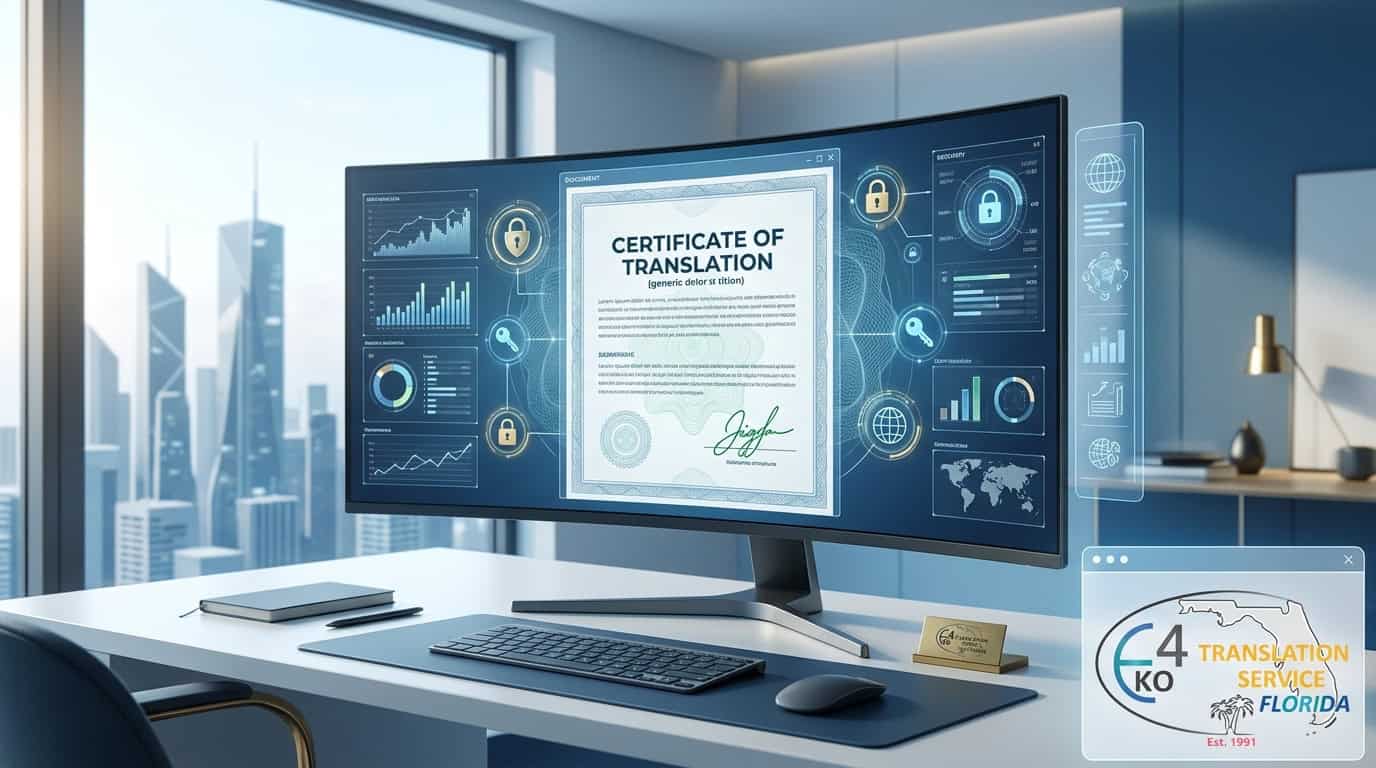
The May 2026 USCIS update specifically highlights the acceptance of electronic signatures, provided they are backed by a verifiable digital audit trail. This is a major shift from previous years where many local offices still insisted on original paper copies with physical stamps. The core of the USCIS translation requirements still mandates a complete and accurate translation performed by a competent translator, but the delivery mechanism has evolved. The agency now favors PDF documents embedded with cryptographic certificates that prove the document has not been altered since the moment of certification.
This modernization effort aligns with broader trends seen across the federal government. For instance, while the U.S. Department of State (Office of Authentications) reported in April 2026 that processing times for federal-level apostilles have stabilized at 4–6 weeks, the shift toward digital authentication is seen as a way to eventually reduce these backlogs. By adopting secure digital certifications, a translation agency can provide faster turnaround times while maintaining a higher level of security than traditional mail-in processes allow. If you are preparing an application and need to ensure compliance with these new digital standards, you can obtain a free estimate from our specialists today.
Florida remains a critical hub for international document flow, particularly as the “Gateway to the Americas.” The administrative shifts at the federal level are mirrored by state-level modernization. As of April 2026, the Florida Secretary of State has fully implemented its e-Apostille Pilot Program for specific business filings. This synergy between federal digital-first policies and Florida’s electronic authentication efforts means that the apostille services industry is undergoing a digital revolution.
However, this transition has also led to a rise in “apostille fraud” awareness. With the increase in digital certificates, reputable agencies like EKO 4 Translations Florida are emphasizing the importance of verification. In May 2026, industry experts noted a surge in educational content focused on how to verify a Secretary of State’s seal in a digital environment. For clients, this means that selecting a provider is no longer just about the lowest price—it is about the technical capability of the agency to produce a document that will be legally recognized by state and federal authorities. Those looking for secure, verified services can order your translation online through our encrypted portal.
Parallel to these administrative changes is the continued evolution of professional standards. In May 2026, the American Translators Association (ATA) has been actively lobbying in Washington D.C. to ensure that “digital-first” does not mean “AI-only.” The ATA recently introduced an “AI-Enhanced Professional” credential, a new standard designed to distinguish human-verified translations from raw machine output. This is particularly relevant under the current USCIS translation requirements, which still require a human to certify the accuracy and completeness of the work.
The industry has largely moved toward a “Human-in-the-Loop” pricing model. This allows a translation agency to offer tiered services, ranging from raw AI for internal use to full, ISO 18587-certified post-editing for legal and government submission. ISO 18587 has become the gold standard in 2026, ensuring that even when AI tools are used to assist in the process, the final product meets the linguistic and cultural nuances that only a professional translator can provide. EKO 4 Translations Florida continues to uphold these high standards, ensuring that every certified translation we deliver is reviewed by an expert who understands the specific legal context of the target jurisdiction.
The administrative news of May 2026 highlights a industry that is becoming more efficient yet more technically demanding. Whether it is the Florida Office of the State Courts Administrator (OSCA) updating interpreter standards to include AI ethics or USCIS embracing cryptographic signatures, the message is clear: the “old way” of handling paper documents is quickly fading. For the consumer, this means faster processing and more secure document handling, but only if they work with an agency that stays ahead of the regulatory curve.
At EKO 4 Translations Florida, we don’t just translate words; we navigate the administrative frameworks that give those words legal power. Our team is fully equipped to handle the latest digital certification protocols required by USCIS and the Florida Department of State. From providing same-day rush services to ensuring that every electronic seal is valid and verifiable, we bridge the gap between complex government regulations and our clients’ needs. As the industry continues to consolidate and modernize, our commitment remains to provide the expertise necessary to move your documents—and your life—forward in a digital world.